Upper Secondary
Years 10 and 11, for students aged fourteen to sixteen: two years of Cambridge IGCSE courses, with English, Mathematics and Science at the core and options chosen around each student’s strengths and plans.
- Ages 14 to 16Years 10 and 11
- Seven IGCSEsThe standard pathway
- August 2027Year 10 opens
Our IGCSE programme combines traditional academic prestige with progressive innovation.
Independent inquiry lies at the heart of our learning philosophy. We empower Upper School students to take ownership of their education through self-directed research, targeted reading and deep analytical study.
Gary CrumbieSecondary Principal
How the two years are built
Every student studies English, Mathematics and Science. The rest of the programme is chosen across seven option blocks, so each timetable keeps its breadth. Choose a subject to see what students study, how it is assessed and where it leads.
The core, for every student
Options, chosen to suit each student
Language and culture
Humanities and social sciences
Creative and performing arts
STEM
Every week
Core Physical Education and Wellbeing, alongside the IGCSE courses. Thai Language is required for Thai students.
English
Cambridge IGCSE First Language English 0500, Literature in English 0475, English as a Second Language 0511
Students with first-language English take First Language English, with Literature in English alongside: poetry, prose and drama. Students who have studied English for fewer than five years take English as a Second Language. Their English teacher guides the choice.
How it is assessed
First Language English
A written paper and a coursework portfolio.
Literature in English
Poetry and prose, drama and an unseen text, with a coursework piece.
Where it leads
A Level English Language with a C or higher in First Language English; A Level English Literature with a B or higher in Literature.
Mathematics
Cambridge IGCSE Mathematics 0580, Additional Mathematics 0606
Number, algebra and graphs, geometry, mensuration, trigonometry, vectors, probability and statistics. Strong mathematicians, on their teacher’s recommendation, add Additional Mathematics: functions, logarithms, series and calculus.
How it is assessed
Mathematics
Two written papers, one without a calculator and one with. Core leads to grades C to G, Extended to A* to E.
Additional Mathematics
Two written papers, graded A* to E. Usually for students achieving or predicted an A or A* in Extended Mathematics.
Where it leads
A Level Mathematics, with a strong B or above on the Extended course.
Science
Cambridge IGCSE Co-ordinated Sciences 0654, or Biology 0610, Chemistry 0620 and Physics 0625
Two pathways. Co-ordinated Sciences covers biology, chemistry and physics and earns two IGCSE grades. Triple Science studies each as a separate IGCSE at a faster pace, for students who have done well in both science and mathematics.
How it is assessed
Co-ordinated Sciences
Three papers. Core leads to grades CC to GG, Extended to A*A* to GG.
Biology, Chemistry and Physics
Three papers in each science, at Core or Extended level.
Where it leads
The sciences at A Level, with BB or above in Co-ordinated Sciences, or a B or above in the separate science on the Extended course.
Thai
Cambridge IGCSE First Language Thai 0518, SBS Bangkok Thai Language Proficiency Course
Required for Thai students, at two levels. IGCSE First Language Thai develops close reading, analysis and composition. Students not yet ready for it take our own proficiency course, based on the Office of the Private Education Commission’s 2026 guidelines for international schools.
How it is assessed
Thai Language Proficiency Course
Progress is assessed through conversations, presentations, written work and everyday class activities.
Mandarin Chinese
Cambridge IGCSE First Language Chinese 0509, Chinese as a Second Language 0523, Chinese (Mandarin) Foreign Language 0547
Taught at the level that suits each student: First Language for native speakers, including Classical Chinese; Second Language; or Foreign Language for learners building everyday fluency. Students are guided to the right level.
How it is assessed
Where it leads
AS Chinese Language or A Level Chinese, depending on the level studied and the grade achieved.
Business
Cambridge IGCSE Business 0264
How businesses work: business activity, people, marketing, operations, finance and the outside influences on a business, with the numeracy to analyse real data and make recommendations.
How it is assessed
Where it leads
A Level Business with a C or higher, and a good grounding for A Level Economics.
Geography
Cambridge IGCSE Geography 0460
Rivers, coasts, ecosystems, tectonic hazards and climate change, alongside population, cities, development, economies and resources. A geography fieldtrip feeds the investigations paper.
How it is assessed
Where it leads
A Level Geography with a C or higher.
Global Perspectives
Cambridge IGCSE Global Perspectives 0457
Students research global issues from personal, local and global perspectives, write an individual report of 1,500 to 2,000 words and plan a team project on a local issue.
How it is assessed
Art and Design
Cambridge IGCSE Art and Design 0400
A wide choice of media: painting, graphic communication, three-dimensional design, textiles and fashion, and photography. Students build a portfolio, then respond to a theme set by Cambridge in an eight-hour supervised test.
How it is assessed
Where it leads
AS and A Level Art and Design with a C or higher.
Drama
Cambridge IGCSE Drama 0411
From script to performance. Students work as actors, directors and designers, perform individually and in groups, and devise an original piece of their own.
How it is assessed
Where it leads
A Level Drama with a C or higher.
Music
Cambridge IGCSE Music 0410
Listening, performing and composing across seven areas of study, from Baroque and Classical music to music for dance, stage and screen.
How it is assessed
Where it leads
A Level Music with a C or higher.
Computer Science
Cambridge IGCSE Computer Science 0265
Computational thinking and programming in Python, with computer systems, networks, cybersecurity, robotics, emerging technologies, databases and SQL. Both papers are taken as digital exams.
How it is assessed
Where it leads
A Level Computer Science with a C or higher.
Design and Technology
Cambridge IGCSE Design and Technology 0445
Students design and make products with users and sustainability in mind, learning materials, structures, mechanisms and electronics, and how products are manufactured.
How it is assessed
Three components
A product design paper, a practical project and a paper on materials.
Where it leads
A Level Design and Technology with a C or higher.
Physical Education
Cambridge IGCSE Physical Education 0413
The science behind performance: anatomy and physiology, health, fitness and training, skill acquisition and psychology, and the social side of sport, alongside four practical activities.
How it is assessed
Where it leads
AS Level Sport and Physical Education with a C or higher.
Core or Extended, decided together
Several subjects, including Mathematics and the sciences, are offered at two levels. The teacher recommends a level in discussion with the student and family.
What we consider
- Academic performanceCurrent grades and test results.
- Academic progressHow learning has moved over time.
- Preparedness and motivationReadiness and enthusiasm for the challenge of the level.
- Future plansHow the level supports what your child hopes to study next.
- WellbeingAbove all, what is best for your child.
From options to certificates
IGCSE choices are made during Year 9, with time to talk them through at home and with our teachers. Families can ask for guidance at any point.
-
Year 9, Term 1
First conversations
A first talk on IGCSE subjects, MidYIS baseline tests and the first academic report.
-
Year 9, Term 1
Advice for families
Parent–teacher conferences, a parent workshop on IGCSE options and one-to-one conversations with tutors.
-
Year 9, Term 2
Options Evening
An options assembly, then an evening with senior leaders, tutors and the careers counsellor.
-
Year 9, Term 2
Choices confirmed
Parent–teacher conferences, the deadline for choices, and confirmation at the end of term.
-
Year 9, Term 3
A head start
Students begin IGCSE content and skills in some subjects.
-
Years 10 and 11
Courses and coursework
Coursework in some subjects is marked by our teachers and moderated by Cambridge.
-
May and June, Year 11
Examinations
Written, oral and practical exams, graded by Cambridge in the UK.
-
Term 1, Year 12
Certificates
Official Cambridge certificates are presented to students.
Beyond the exam timetable
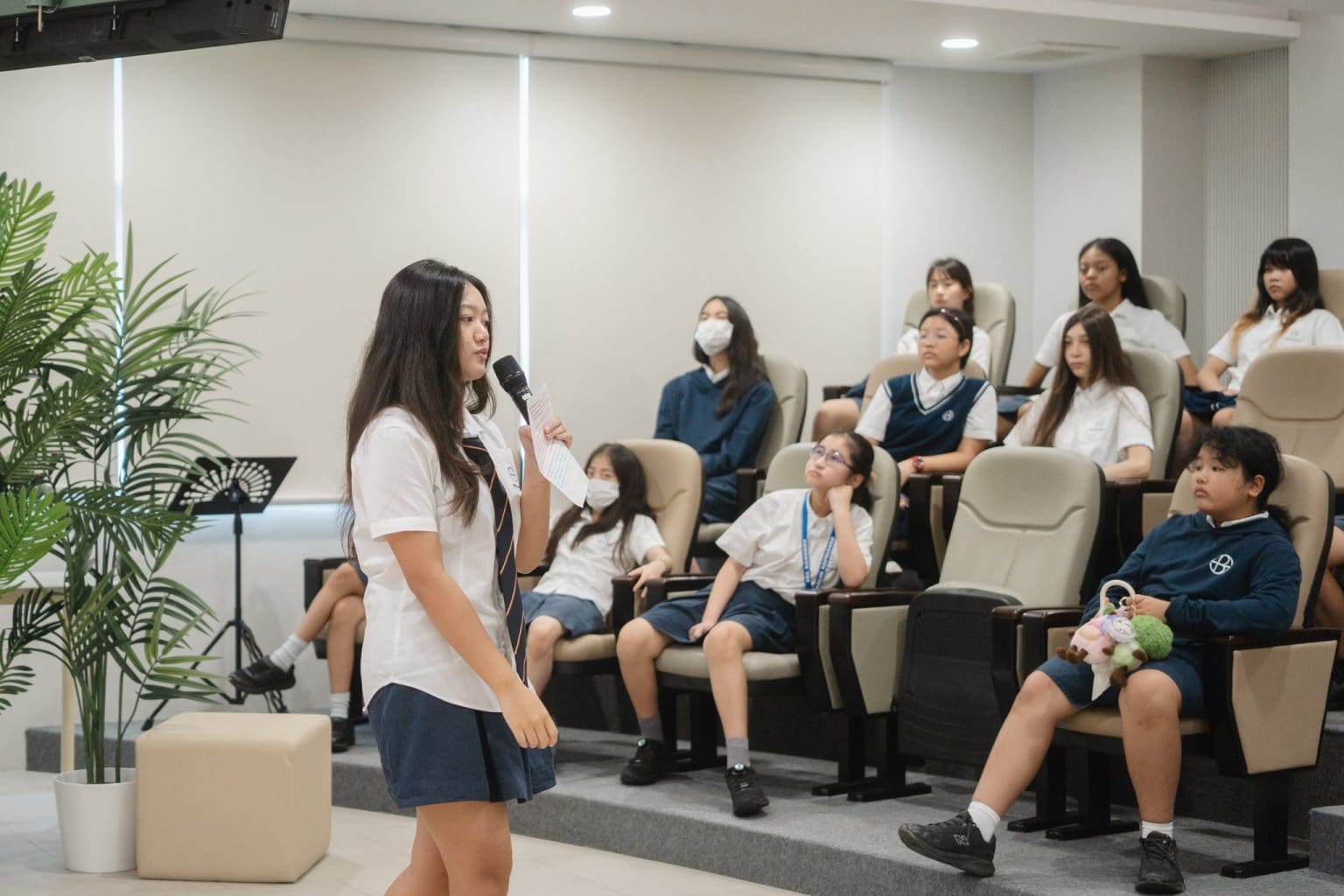
Upper Secondary is about more than results. Every week leaves room for sport, wellbeing, service and the interests that make each student who they are.
- Core Physical EducationWeekly sessions for every student, building fitness, teamwork and healthy habits for life.
- Wellbeing DaysOff-timetable days on mental health, resilience, digital wellness and emotional intelligence.
- Active8 activitiesAfter-school activities that show a student’s interests beyond their subjects, which universities look for in applications.
- Service LearningProjects that meet real needs in school and the wider community, from conservation to peer mentoring and fundraising.
- University guidanceFamilies can meet university counsellors from across the AOI group to talk through how subject choices shape future pathways.
- Ror DorMilitary training for eligible Thai students, subject to the requirements of the Military Training Institution.
When does Year 10 open at SBS Bangkok?
In August 2027. Students begin their two-year IGCSE courses at the start of Year 10.
When are the IGCSE examinations?
At the end of the course, in May and June of Year 11. Cambridge grades the papers in the UK, and certificates are presented in Term 1 of Year 12.
Does every student take the same subjects?
No. Everyone studies English, Mathematics and Science, and the rest of the programme is chosen across seven option blocks. Every student also takes Core Physical Education and Wellbeing, which are not examined.
How many IGCSEs will my child take?
The standard pathway is seven IGCSE subjects. Students who joined English-medium schooling later in Years 7 to 9 may be advised to take fewer, with extra language support, so they can do their best in each.
How are IGCSEs graded?
From A*, the highest grade, to G. Some subjects include coursework, which our teachers mark and Cambridge moderates to keep standards the same worldwide.
How should my child choose options?
Choose subjects they enjoy and do well in, and think ahead to A Level. A future engineer, for example, will need a strong grade in Extended Mathematics. Choices should suit your child, not their friends.
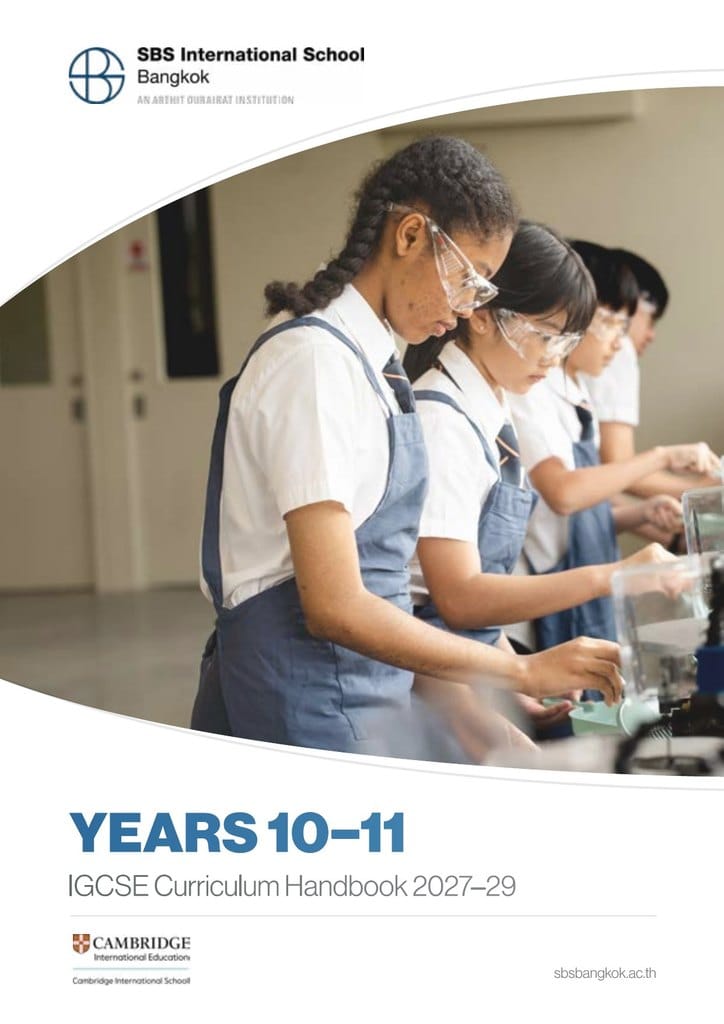
Curriculum handbook
The IGCSE handbook sets out every subject in detail: its aims, what students study, how it is assessed and where it leads.
Academic Scholarship
For students joining SBS Bangkok in Year 10, at the start of their IGCSE courses, with strong academic achievement and high academic potential.
- What to prepareSchool reports, a personal statement and evidence of achievements, such as certificates.
- AssessmentAn academic assessment and an interview with the Principal or Head of School.
- DecisionWithin 48 hours of the interview.
Come and see Secondary for yourself
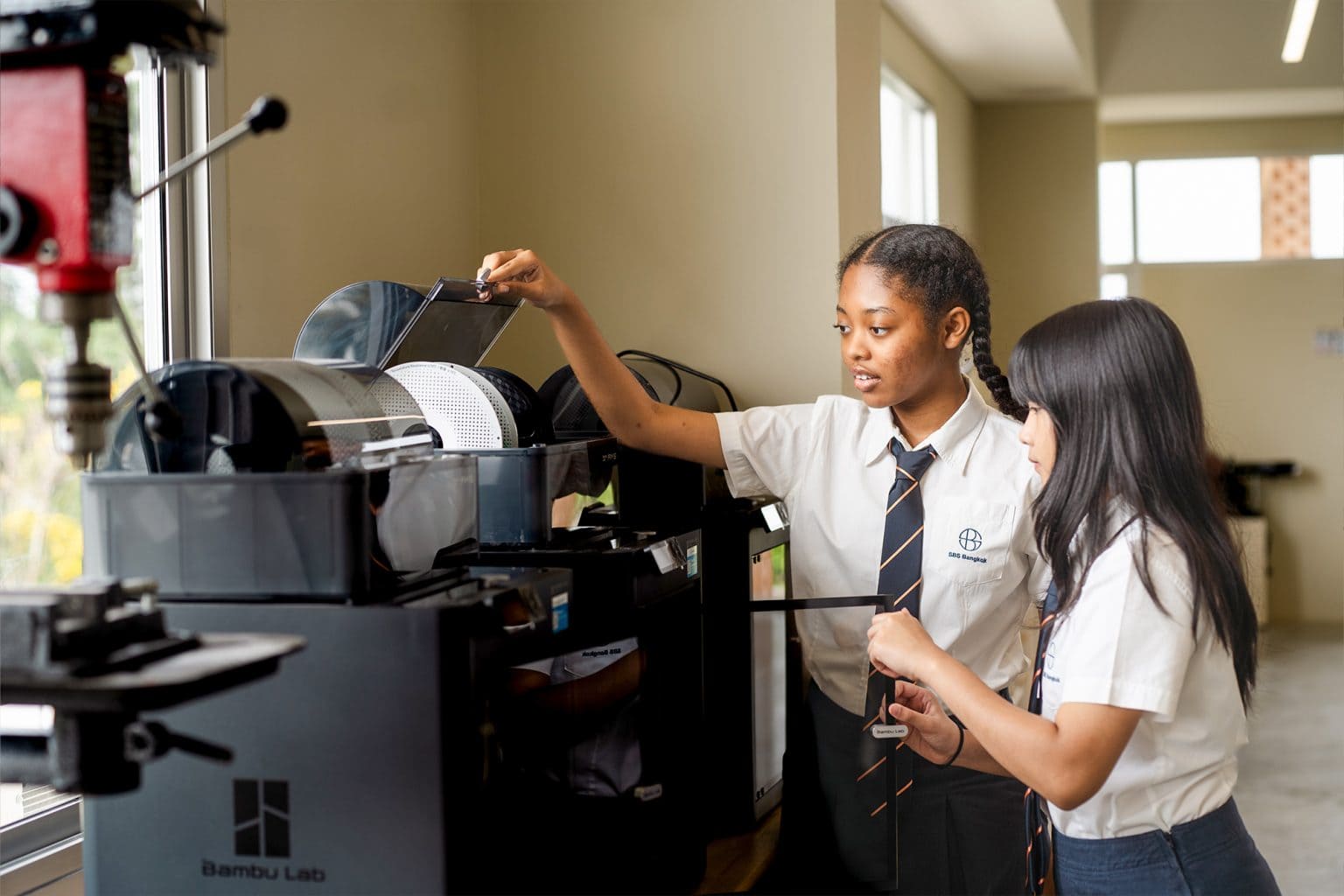
Visit on a school day, meet our Secondary team and see the labs, studios and workshop in action.